Wednesday, October 22, 2014

Cincinnati, We Have a Problem


Twenty-four years ago, the 1990 Cincinnati Reds were on their way to winning the World Series.  They finished the regular season in first place at 91-71, five games ahead of the Los Angeles Dodgers.  They would go on to defeat the Pittsburgh Pirates in six games, and then sweep the Oakland A’s, who, despite not winning the World Series, was clearly the best team in baseball that year.  But the Reds got hot, Jose Rijo gave up nine hits and one earned run in 15 1/3 innings, and that was that.

Hooray Reds.  But today isn’t about the Reds of 24 years ago.  It’s about the Reds of 25 years ago.  Specifically, we’re going to look at not only the team leader, but the league leader in at bats, Todd Benzinger.  Were the Reds so bad because Benzinger got so many at bats, or did Benzinger get so many at bats because the Reds were so bad?  Either way, the results weren’t good.

Every Rose has it's thorn.
Under the scourge of manager Pete Rose’s throwing of baseball games, the 1989 Reds finished 75-87, fifth place in the NL West.  At the end of June, they were a respectable 41-37, but a 7-19 July and a 10-18 September sealed their fate.  Barry Larkin hit .342, but he only played in 97 games after missing most of July and all of August.  Eric Davis hit 34 home runs and drove in 101 runs, but his stolen base totals fell off a cliff, down to 21 from a high of 50 just two years earlier.  The five starters that started the most games for the Reds that year – Tom Browning, Rick Mahler, Danny Jackson, Rijo and Scott Scudder – combined to go 41-51.  Closer John Franco saved 32 games, but also went 4-8.  Two-thirds of the Nasty Boys – Rob Dibble and Norm Charlton – were pleasant surprises, combining for a 18-8 record.  Dibble was second on the team in wins at 10.

Let’s get back to this Benzinger fellow.  He would have been listed on the back of the 1989 Topps “Reds Team Leaders” card in several places – games played, at bats, runs, hits, doubles, strikeouts, and for some reason that defies logic, intentional walks.  In addition, he was second in triples, home runs, and RBIs, and third in walks.  All of this goes back to the sheer number of games he played in – 161 – a full 30 games more than second place Davis.  Not sure what kept him out of action on April 30th, but I’m sure it was important.  So Benzinger was good at playing in a lot of games that year, and not much else.  Let’s take a look back and see if anyone saw that coming.

Benzinger was drafted in the fourth round of the 1981 Major League draft by the Boston Red Sox out of New Richmond High School in New Richmond, OH.  To date, he is the only major leaguer produced by the Lions.  Fellow fourth rounders that year include future teammate Paul O’Neill, Shane Mack and Eric Plunk.  Fun fact!  By some accounts, Benzinger was the worst player drafted that year.  While only 10 of the 26 players drafted reached the majors, Benzinger has the lowest WAR of the 10 at -2.7.

Upon signing, Benzinger was assigned to A- ball Elmira, where he hit .241 with 10 doubles, a triple, two home runs and eight RBIs in 41 games split between the outfield and first base.  This earned him a promotion to A ball Winston-Salem, where he hit .219 with 19 doubles, a triple, five home runs and 46 RBIs in 121 games, also in the outfield and at first base.  You’re going the wrong way there, Todd.

Benzinger found himself back in A ball in 1983, this time at Winter Haven.  He did better this time, hitting .279 with 34 doubles, five triples, seven home runs and 68 RBIs in 125 games mainly in the outfield, but he also had two games at first base, and one game at third base.  In the game he played third base, he had one chance, and promptly made an error, giving him a minor league career fielding percentage of .000 at the position.  Despite not being able to field third base, the Red Sox promoted him to AA New Britain for the next season, where he hit .258 with 25 doubles, five triples, 10 home runs and 60 RBIs.  They still couldn’t figure out where to play him though, as he again split his time between the outfield and first base.

Isn't the "o" long if
there's only one "d"?
The next three years are what is known to Benzinger as The Pawtucket Chronicles.  In AAA, he combined to hit .251 with 26 doubles, three triples, 22 home runs and 79 RBIs in 1985 and 1986.  In those two seasons, he only played three games at first base.

By the time 1987 came around, it was pretty much crap or get off the pot for Benzinger.  And crap he did.  In 65 games, he hit .323 with 17 doubles, three triples, 13 home runs and 49 RBIs.  He played about three-quarters of his time in the outfield, combining for a fielding percentage of .992, easily the best of his minor league career.

Not really sure why the
Brewers had a 60 year old
ex-fullback pitching.
The Red Sox called up Benzinger on June 21st, 1987.  In a 4-2 win over the New York Yankees, he pinch hit for catcher Marc Sullivan in the bottom of the eighth, drew a walk, and trotted home when Ellis Burks took Bob Tewksbury deep.  The next day, Benzinger would get his first career hit off of John Henry Johnson in a 5-2 victory over the Milwaukee Brewers.  Two days later, he would knock in four runs in an 8-7 win again over the Brewers.  He was hitting .310 through the end of June, and after playing sparingly in July, his average was only down to .288.  He played quite a bit more in August, but at the end of that month, he was only hitting .234.  After the league made some adjustments to him, he made his own adjustments, collecting 11 multi hit games in 31 games from September 1st on, including a three hit, seven RBI day in a 9-8 loss to the Tigers on September 15th.  That game also featured his first career grand slam.  He would finish his first partial season hitting .278 with 11 doubles, a triple, eight home runs and 43 RBIs.  In his 63 games in the field, 61 of them were in the outfield, where he had a fielding percentage of .987 across all three positions.

Benzinger returned to Boston in 1988.  He played sparingly in the first half of the season, only playing in 33 games through the end of June while batting .238 with two home runs and 16 RBIs.  After hitting .324 in July, his season average was all the way up to .282.  This included a three-run, walkoff home run on July 20th, in a 9-7 win over the Minnesota Twins.  Unfortunately, that was pretty much the high water mark of the season.  On August 4th, he had his first two-home run game.  He would add four more home runs through August 26th, but he didn’t hit another in his final 33 games that season.  Overall, he hit .254 with 28 doubles, a triple, 13 home runs and 70 RBIs.  Playing about two thirds of his games at first base, he had an overall fielding percentage of .989.


Before the start of the 1989 season, Benzinger was traded with Jeff Sellers and Luis Vasquez to the Cincinnati Reds for Nick Esasky and Rob Murphy.  Sellers would pitch in one minor league game for the Reds, and would never pitch in the majors again.  Vasquez would never make it to the majors, but he did give AAA Nashville 47 games, compiling a 15-19 record for them.  On the other end of the trade, Esasky gave the Sox one season, hitting .277 with 30 home runs, 108 RBIs, and an 18th place finish in the American League MVP voting.  Murphy would be bullpen filler for two seasons for the Sox, throwing 142 games, compiling a 5-13 record with 16 saves.

Unretires, becomes Marlins
new first baseman.
Benzinger set out to prove the Red Sox made a horrible decision in trading him, a journey which ultimately failed miserably.  Now a full time first baseman, he was hitting .225 at the end of April, with no home runs, six RBIs and four walks vs. 12 strikeouts.  By the midpoint of the season, things hadn’t gotten much better.  Pretty much the highlight of the first half was his grand slam hit on June 27th.  He would add another grand slam in the second game of a double header on August 18th, but that was about the only significant thing he did in the second half.  He finished the season hitting .245 with 28 doubles, three triples, 17 home runs and 76 RBIs, with 44 walks and 120 strikeouts.  He was intentionally walked 13 times, with six of those occurring in the last month of the season.  This was a first baseman with an on base percentage of .293 and a slugging percentage of .381.  For reference, Juan Pierre’s career slugging percentage was .361.  If Pierre could have gotten 150 more bases over the course of his 14 year career, he would have had the same slugging percentage as Benzinger.


I can't believe I found this on the internet.
Actually, I can.
Benzinger had one thing going for him in 1989.  Health.  He played in far more games (161) than the second place player on the team – Davis with 131.  The 1989 Reds had 20 players play in 40 or more games.  That number in 2014 was only 14.  Even the 2014 Rangers, probably the most injured team in the game this year, only had 16 players play in 40 or more games.  With health on his side, and a low walk rate, Benzinger led the league in at bats with 628.  In addition, he was fifth in the league in games played, fourth in plate appearances, seventh in strikeouts, and third in sacrifice flies, putouts, games at first base, and fielding percentage.  Despite his efforts, he accumulated -0.5 WAR on the year.  Fun fact – I remember looking at the back of Benzinger’s baseball card in 1990, studying the stats, and found it interesting that he had the exact same number of at bats – 628 – that he did in the previous two years combined – 223 and 405.  So if you want to know where my love of baseball is rooted, this is what I did for fun as a child – studied the backs of baseball cards of the ilk of players such as Todd Benzinger.

A combination of health and talent, or lack of both, would conspire to ensure Benzinger would never post anything close to his 1989 numbers again.  In 1990, he actually was on fire to start the season, hitting .339 in April, and he was still at the .300 mark as late as June 3rd.  A month later, it looks like the injury bug hit.  At the time, he was hitting .281 with four home runs and 39 RBIs.  He had only missed three of the Reds first 74 games to that point of the season.  After that point of the season, he would only play another 47 games, with only 25 starts, hitting .190 with one home run and seven RBIs with three walks and 26 strikeouts.  For the season, he hit .253 with 14 doubles, two triples, five home runs and 46 RBIs.

Fortunately for the Reds, prior to the 1990 season, they acquired William Harold (Hal) Morris from the Yankees.  Through the first half of the season, Morris played sparingly.  As of June 19th, he was only hitting .222.  Between June 20th and July 22nd, he hit .508, raising his batting average to .419 on the season.  The rest of the way out, he hit .309, and had completely replaced Benzinger at first base.  Both players were now World Series champions, but they were headed in opposite directions.

1991 would be Benzinger’s last season in Cincinnati.  On Opening Day, he went 3-4 with four RBIs, only a home run shy of the cycle, in a 6-5 victory over the Houston Astros.  Over his next 50 games, through July 7th when he was traded to the Kansas City Royals for Domingo Mota and Chris Gwynn, he hit .168 with two doubles, a triple, a home run and seven RBIs.  The change of scenery seemed to be a boost to him, as for the rest of July for the Royals, he hit .347 with four doubles, a triple, two home runs and 18 RBIs.  This included a grand slam on July 23rd, which proved to be the game winner in an 8-7 victory over the Milwaukee Brewers.  Over the final two months of the season, he played mainly replacement level ball, hitting .275, but he didn’t hit a single home run, which wasn’t exactly ideal for an American League first baseman.  For the season, he hit .262 with 18 doubles, five triples, three home runs and 51 RBIs.

In December of 1991, Benzinger was traded yet again, this time to the Los Angeles Dodgers.  He probably assumed when he was traded that he would be replacing Eddie Murray at first base, after Murray signed with the New York Mets.  That assumption would be false, as the Dodgers had a young Eric Karros coming up.  Karros hit .316 with 22 home runs and 101 RBIs at AAA Albuquerque in 1991.  Karros would go on to win the NL Rookie of the Year award at first base for the Dodgers in 1992.

In 1992, Benzinger wouldn’t even get his first RBI of the season until May 17th.  His two hit performance that day raised his average to .207.  He would try to make the most of his playing time, as a week later, he would hit his first home run of the season, kicking off a five game streak where he knocked in 11 runs, including a grand slam on May 27th.  During that streak, his average hit a season high of .265.  For the most part though, he was in the .230s and .240s the entire season.  The only other meaningful thing he did that year was hit another grand slam as a pinch hitter in the top of the ninth inning on September 4th.  That briefly put the Dodgers ahead, but they still lost to the Pirates when they put up three runs in the bottom of the frame, winning 6-5.  Overall, Benzinger hit .239 with 16 doubles, two triples, four home runs and 31 RBIs, splitting his time between the outfield and first base.

Benzinger would head north in 1993, signing with the San Francisco Giants.  Not sure what he was exactly thinking with the first base position locked down by Will Clark, but whatever.  Through the first two months of the season, he played in only six full games, and he was only hitting .189.  The next two months saw only four complete games, but he had brought his average up to .244.  In the final two months of the season, Benzinger actually played in 21 full games, and over that span, he hit .326.  This included a pair of two-home run games on August 30th and September 18th.  The Giants would win 103 games, but that was only good for second place, as they finished one game behind the Atlanta Braves.  For the season, Benzinger would hit .288 with seven doubles, two triples, six home runs and 26 RBIs.

Benzinger would return to the Giants in 1994, this time with the starting first base job in hand after Clark signed with the Texas Rangers.  Unfortunately, his second half magic from the previous season couldn’t carry over into the new year, as in the first half, he only hit .249 with seven home runs and 22 RBIs.  That’s an average month for Adam Dunn, but when you’re talking about three months, that’s not very good for a first baseman.  He had mostly the same results for most of July, but towards the end of the month through the final game on August 10th, he hit .516 over his final 31 at bats.  Benzinger was sad to see the season cancelled by the strike, just as he was getting hot.

Benzinger once again was with the Giants to start the 1995 season.  Unfortunately, the Giants had now decided that the Todd Benzinger era at first base was over, and J.R. Phillps was the future.  Benzinger’s first seven games of the season all featured one hitless at bat.  On May 13th, he would play in his final complete game, and a day later, he would play in his last career game.  Fittingly enough, Benzinger was intentionally walked in his final career at bat.  It wasn’t a good idea in 1989, and it wasn’t a good idea in 1995.  Darren Lewis singled home Royce Clayton to beat the Pirates 2-1 in the bottom of the 10th.  The next day, the Giants released Benzinger.  At the time of his release, Phillps was batting .119.  That’s how committed the Giants were to the idea that Benzinger was not part of their future plans.

Ten days after being released by the Giants, Benzinger signed a minor league free agent deal with the Yankees.  At AAA Columbus, he only played in 12 games, but despite hitting .280, he only had one home run.  An AL first baseman in the mid-1990’s was going to need to hit more than 13 or 14 home runs in a season, so on June 9th, the Yankees released him, ending his professional career.

For his career, Benzinger hit .257 with 135 doubles, 18 triples, 66 home runs and 376 RBIs.  He only had 181 walks vs. 552 strikeouts.  In the field, he had a .994 fielding percentage in 622 games.  About 75% of those were at first base, and the remainder in the outfield, except the one game he played third base – for one inning.  But he didn’t make an error!

In his magical 1989 season, he led the National League in at bats and outs made.  He was third in sacrifice flies and putouts, fourth in plate appearances, and fifth in games played.  His fielding percentage of .994 at first base is actually 32nd best of all time, right between Adam LaRoche and Wally Joyner.

After his playing days were over, he managed A ball Dayton in the Reds farm system.  A .404 batting average will make you immortal.  A .404 winning percentage, especially in A ball, will make you unemployed.

There you have the life and times of Todd Benzinger.  Sadly, “Mercedes” as he was known, probably didn’t ever make enough to actually buy a Mercedes.  He did, however, lead the league in at bats in 1989, and that means something to someone – 11 year old Charles Wood.

Monday, October 13, 2014

Mismanagement Monday

Mondays are the best day of the week for mismanagement.  There’s always a cluster of work that somehow came in over the weekend, and that just adds to the pile left from Friday afternoon (it’s ok to admit that you check out at 1:35 every Friday, I won’t tell).  By 11:00 am on Monday, you have half of Friday, a weekend pile, and then the work from the people that DON’T work on weekends.  There’s probably a lot of talent in your workplace, but it’s probably mismanaged.  And Monday is probably the day that it is more apparent than the other days of the week.  Kind of like the early 1990’s Toronto Blue Jays.

DON'T CROSS THE BORDERS!
The Blue Jays of the early 90’s had a lot of success.  They were back to back World Series champs in 1992 and 1993.  They had established stars such as Paul Molitor, Joe Carter, Tony Fernandez, Dave Stewart and Jack Morris, and youngsters John Olerud, Roberto Alomar and Pat Hentgen.  With all of that talent around, no one noticed that Pat Borders hit a combined .248 with 25 home runs between 1992 and 1994.  His fielding percentage was .987 during that time, which I suppose is why no one really cared what Pat Borders was doing when he wasn’t catching.  He still wasn’t Ivan Rodriguez-good, who won the Gold Glove award those seasons with a … .987 fielding percentage.  Of course, Rodriguez threw out 131 batters in those seasons.  Borders only threw out … 138.  It was a much lower percentage of base runners though.  OK, I guess this had no point other than to make fun of Pat Borders.

The only thing that Borders seemed to be REALLY good at was blocking a young catcher in the Blue Jays’system from coming up.  That catcher was Carlos Delgado.  In the minors, Delgado had a .982 fielding percentage at catcher, which wasn’t horrible, and seeing how during those seasons he hit .298 while hitting 98 home runs, I’m guessing the slight falloff could have been overlooked.  I’m not saying that a 20 year old Delgado could have came up and hit .324 with 30 home runs and 100 RBIs like he did at A+ Dunedin in 1992, but he probably could have matched Borders’ .242 with 13 home runs and 53 RBIs.  Those numbers were almost identical in 1993 for Borders, hitting .254 with nine home runs and 55 RBIs, while Delgado, advancing to AA Knoxville hit .303 with 25 home runs and 102 RBIs.  He even drew 102 walks that year.  Borders only walked 155 times in his CAREER.

Now that we’ve gotten all that out of the way, let’s take a look at Delgado’s career.  He was signed by the Blue Jays as an amateur free agent out of Aguadilla High School in Aguadilla, Puerto Rico in October 1988.  Upon his signing, he was assigned to A- St. Catharines, where he hit .180 with five doubles and 11 RBIs in 31 games.  He found himself back there for the 1989 season, where he did much better, hitting .281 with 13 doubles, six home runs and 39 RBIs in 67 games.  In those two combined seasons, he had 58 walks and 104 strikeouts.

In 1991, other than one game where he went hitless in three at bats for Syracuse, Delgado spent the season in A ball Myrtle Beach.  There, he hit .286 with 18 doubles, two triples, 18 home runs and 10 RBIs, with 75 walks and 97 strikeouts.  You can see his 1992 and 1993 statistics above.
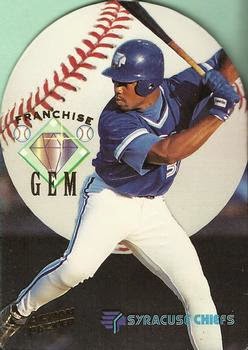
After a very brief callup in 1993 to the Blue Jays, he would return to Syracuse for the 1994 season.  In 85 games, he hit .319 with 11 doubles, 19 home runs and 58 RBIs, with 42 walks and 58 strikeouts.  He was yet again in Syracuse in 1995.  In 91 games, he hit .318 with 23 doubles, four triples, 22 home runs and 74 RBIs, with 45 walks and 78 strikeouts.  It was this season that he also found himself out from behind the plate, playing 14 error free games in left field, and 79 games at first base, with a fielding percentage of .995.  In both 1994 and 1995, he also got a bit of time with the Blue Jays.  Let’s take a closer look at his big league career.

Delgado would make his major league debut on October 1st, 1993 in a 7-2 loss to the Baltimore Orioles.  He entered the game as catcher for Randy Knorr in the bottom of the sixth inning, he came to bat once that day in the eighth, drawing an eight pitch walk off of Todd Frohwirth.  One batter later, he was erased off of a ground ball double play by Alfredo Griffin.  Two days later, he would taste sweet victory as the Blue Jays beat the Orioles 11-6.  Pinch hitting in the eighth inning for Paul Molitor, he popped out to short to end his season hitless.
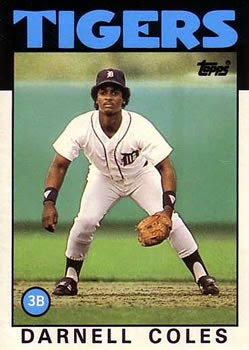
Third base, left field,
whatever. There's enough
Darnell Coles to go around.
In 1994, Delgado would start the season with the Blue Jays as the opening day left fielder.  This was the first professional game that he ever played a position other than catcher.  The move instantly paid off, as he went 5-15 with three home runs in his first three games that season.  On April 11th, he went 2-4 with two home runs and five RBIs in a 14-5 win over the Oakland A’s.  By the end of April, he was only hitting .234, but he had eight home runs and 21 RBIs.  He also had 11 walks and 28 strikeouts.  Unfortunately, after May 1st, he hit .189 with only one home run and three RBIs, despite his BB/K ratio improving to 14 walks and 18 strikeouts.  His on base percentage over that span was .377 due to his increased walks, but still, the Blue Jays decided that June 8th would be his last day in the majors, and they sent him back to Syracuse.  After all, the Blue Jays DID have Mike Huff, who at that point in his career was a .230 hitter with five home runs and 41 RBIs in 217 games.  And don’t forget Darnell Coles, who at that point in his career was a .248 hitter with 67 home runs and 335 RBIs in 825 games.  Huff and Coles shared left field while Delgado was back in Syracuse abusing the opposition.  Borders hit .247 with three home runs and 26 RBIs that season as well.  Delgado ended the season at .215 with two doubles, nine home runs and 24 RBIs, with 25 walks and 46 strikeouts.  In his first ever attempt at anything other than catcher, he made two errors 41 games in the outfield, and added two assists.

Delgado once again opened the season with the Blue Jays in 1995.  This time, they decided they REALLY wanted to mismanage him.  In his first seven games that season, he only received one plate appearance.  In his next game, he went 0-4 with three strikeouts, before finally getting his first hit in his next game.  His first home run of the season came on May 23rd, as a pinch hitter in a 10-6 victory over the Kansas City Royals.  Five days later, he was only hitting .154 with one home run and three RBIs when he was sent back to Syracuse.  After putting up gaudy numbers again in AAA, he was called back up at the end of the season.  Over the final month, he hit .169 with two home runs and eight RBIs.  Overall for the season, he hit .165 with three doubles, three home runs and 11 RBIs, with six walks and 26 strikeouts.
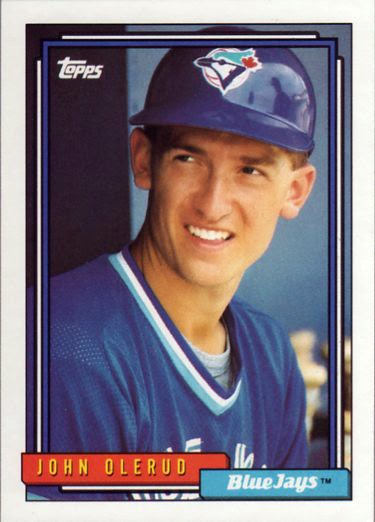
Delgado would return to the majors for good for the 1996 season.  By now, he had officially made the transition to first base, although with Olerud already having established himself there, Delgado primarily served as the DH.  He was hitting .300 as late as June 19th, but he ended the season at .270 with 28 doubles, two triples, 25 home runs and 92 RBIs, with 58 walks and 139 strikeouts.  Fun fact – in the two games where he had a triple, he also homered, but those were the only two hits he had those days.  No cycle for you!

Delgado had similar numbers in 1997.  Again hitting .300 in mid-June, he had a stretch from June 16th through August 6th where he hit.184, before finishing the season at an even .300 from August 7th on.  He would hit his first career grand slam on April 25th, followed by two more on June 6th and July 24th.  He homered in four straight games in early June, and fell a double short of the cycle on July 11th.  Overall for the season, he hit .262 with 42 doubles, three triples, 30 home runs and 91 RBIs, with 64 walks and 133 strikeouts.  With Olerud having moved on to the New York Mets, Delgado was now the primary first baseman.  In 119 games, he only made 12 errors, good for a .988 fielding percentage.  This would actually be his worst fielding percentage of any season where he played over 100 games at first base (it was .983 in 27 games there in 1996).

In 1998, Delgado took a big step toward showing the world the player he would become.  He would hit grand slams on May 7th and August 12th.  The May 7th game was also his first career five hit game.  He had his first career three home run game on August 4th.  He had a 19 game hit streak that bridged May and June, and an on base streak of 38 games.  He was batting .301 on September 1st, but from there on out, a horribly unlucky BABIP of .170 translated into a .244 batting average, even though over that span he still had 11 home runs and 19 RBIs, with 20 walks and 19 strikeouts.  Overall for the season, he hit .292 with 43 doubles, a triple, 38 home runs and 115 RBIs, with 73 walks and 139 strikeouts.  He was AL Player of the Week the weeks of June 7th (.407 average, four home runs, nine RBIs) and August 23rd (.370 average, four home runs, 10 RBIs).  He would finish a distant 21st in the AL MVP voting.  Manning 141 games at first base, he only made 10 errors, good for a .992 fielding percentage.


Delgado’s average dipped a bit in 1999, but many of his other numbers improved.  It was a season of ups and downs, as he was hitting .241 on April 28th, .286 on May 19th, and .246 on August 3rd, before hitting .340 from that point out.  He had a six game streak in early August where he hit .577 with eight home runs and 13 RBIs.  In total, he hit .272 with 39 doubles, 44 home runs and 134 RBIs, with 86 walks and 141 strikeouts.  He would finish 12th in the AL MVP voting, and would win his first Silver Slugger award.  In the field, he would play in 147 games at first base, committing 14 errors, good for a .990 fielding percentage.
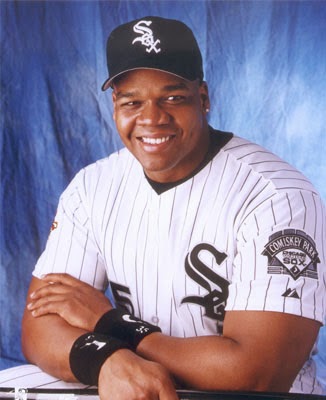
So, you're saying, I should
have won MVP that year too?
In 2000, at the age of 28, Delgado had arguably his best season in a career full of great seasons, but it didn’t start out that way.  After the first eight games, he was only hitting .138 with no home runs.  By the end of April, he had that average up to .319 with eight home runs.  In June, he played in 26 games, and had more than one hit in 14 of them, hitting .411 with nine home runs and 26 RBIs, including a grand slam on June 7th.  In the only game of the season where he hit a triple, he fell a home run short of the cycle in an 8-7 loss to the Royals on August 7th.  He would add another grand slam on September 17th, although he faded a bit down the stretch, only hitting .245 with two home runs that month.  Overall, he would hit .344 with a league leading 57 doubles, one triple, 41 home runs and 137 RBIs, with 123 walks and 104 strikeouts.  His increased average and walk rate made this on base percentage jump to .470, and his OPS was 1.134.  He was AL Player of the Week the weeks of April 23rd (.480 average, four home runs, eight RBIs), June 11th (.556 average, four home runs, 13 RBIs), and July 9th (.524 average, one home run, eight RBIs).  He played in all 162 games that season, all at first base, with only 13 errors equaling a .991 fielding percentage.  He was an All Star for the first time in his career, again won a Silver Slugger award, and finished fourth in the AL MVP voting behind Jason Giambi, Frank Thomas and Alex Rodriguez.  He won the AL Hank Aaron award and The Sporting News Major League Player of the Year award.

Delgado wasn’t quite able to duplicate that success in 2001.  At the end of April, he was “only” batting .293, but he added 10 home runs and 22 RBIs, thanks to two games with three home runs each and one game with two home runs.  He was only batting in the .250’s at the end of May, June, and July before hitting .328 after August 1st.  On the season, he hit .279 with 31 doubles, one triple, 39 home runs and 102 RBIs, with 11 walks and 136 strikeouts.  He was AL Player of the week the week of April 8th, when he hit .368 with five home runs and 10 RBIs.  One thing that very well may have hurt his numbers were fewer opportunities with runners on.  He was intentionally walked 22 times that season.  He had 18 the year before, but 11 of those were in the second half of the season, which may have also contributed to his slightly lower numbers then as well.  Playing all 162 games again, he only made nine errors, good for a fielding percentage of .994.

Delgado would miss the majority of August and only play in 143 games in 2002, but he would put up similar numbers to the previous season.  He was hitting .280 at the end of April, but from that point out, his average didn’t get much above the .250’s until he caught fire at the end of the season, hitting .435 with 10 home runs and 22 RBIs in the last 20 games that year.  Overall, he hit .277 with 34 doubles, two triples, 33 home runs and 108 RBIs, with 102 walks and 126 strikeouts.  He was AL Player of the Week for the week of September 29th, when he hit .450 with four home runs and 11 RBIs.  In the field, he had 12 errors at first base, good for a .991 fielding percentage.
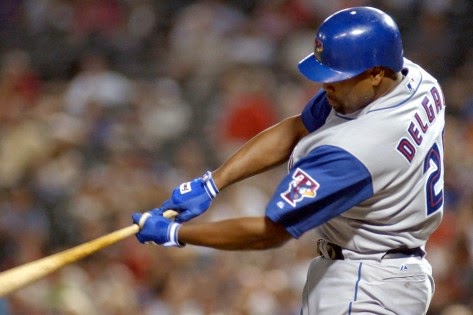
In 2003, Delgado would again find himself as an All Star.  He came out of the gate strong, hitting .365 in the month of April.  He hit grand slams on June 6th and September 28th.  On September 25th, he was 4-4 with four home runs and six RBIs in a 10-8 win over the Tampa Bay Devil Rays.  For the year, he hit .302 with 38 doubles, one triple, 42 home runs and a league leading 145 RBIs, with 109 walks and 137 strikeouts.  He was AL Player of the Week for the week of August 28th, when he hit .318 with six home runs and 11 RBIs.  Along with the All Star nod, he was a Silver Slugger, and finished second in the AL MVP race behind Alex Rodriguez.  He only made 10 errors in the field for a .993 fielding percentage.

2004 would mark Delgado’s last year in Toronto.  His April started off slow, as he was only hitting .119 through the first 12 games of the season, but he hit .415 over the last 10 games to finish the month at .265.  By May 29th, his average was down to .227.  He would miss all of June and the first few games of July, but he still wasn’t really right, with his average falling slightly to .221 by the end of July.  From August 1st on, he hit .330 to somewhat salvage his season.  By the end of the season, he was hitting .269, his highest mark since May 3rd, with 26 doubles, 32 home runs and 99 RBIs, with 69 walks and 115 strikeouts.  He was AL Player of the Week for the week of September 5th, when he hit .381 with three home runs and seven RBIs.  He only played in 128 games, and despite missing time, he still played most of them at first base.  He only made five errors, setting a career high for fielding percentage at .996.
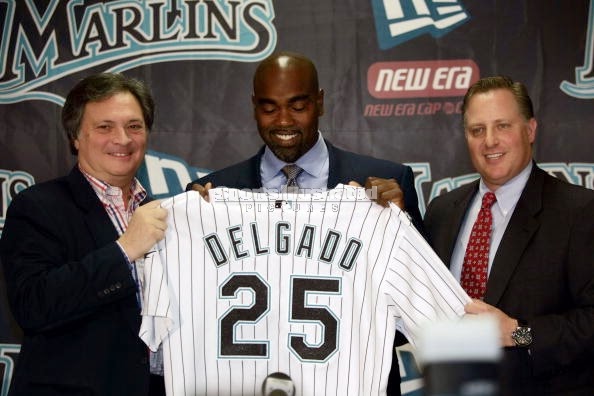
Why is my name and number ironed on?
In 2005, Delgado would switch leagues, signing with the Florida Marlins.  Back at full health, he once again continued to do Carlos Delgado things.  He hit safely in 15 of 22 games that April, finishing the month at .300.  He missed the last few games in July and some games the first of August, but other than that, he was pretty much back to playing every day.  In 144 games, he hit .301 with 41 doubles, three triples, 33 home runs and 115 RBIs, with 72 walks and 121 strikeouts.  His only grand slam of the season came in a pinch hit at bat on July 7th in an 11-3 victory over the Milwaukee Brewers.  He would finish sixth in the NL MVP voting.  In the field, he made 14 errors at first base, which was still good for a .989 fielding percentage.
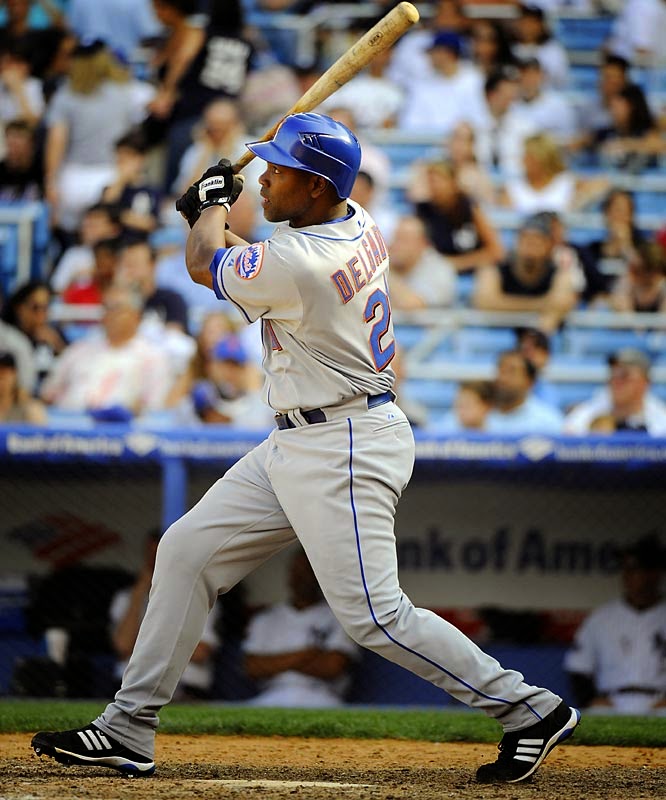
In the offseason, Delgado was traded to the New York Mets for Grant Psomas, Mike Jacobs and Yusmeiro Petit.  His numbers would take a dip, but he was still a very effective player.  He came out of the gate strong, hitting .298 with nine home runs and 20 RBIs in 24 games in April, but his average had fallen to .250 by the end of May.  He was hitting .247 in mid-August before finishing the season hitting .320.  Overall, he hit .265 with 30 doubles, two triples, 38 home runs and 114 RBIs, with 74 walks and 120 strikeouts.  He finished a distant 12th in the NL MVP voting.  He only committed eight errors at first for a .994 fielding percentage.  With the Mets winning the NL East, Delgado made the playoffs for the only time in his career.  He made good use of his time, hitting .429 with a home run and two RBIs in a sweep of the Los Angeles Dodgers.  In the seven game loss to the St. Louis Cardinals, he hit .304 with three doubles, three home runs and nine RBIs.  That combined for a .351 average and a 1.199 OPS.
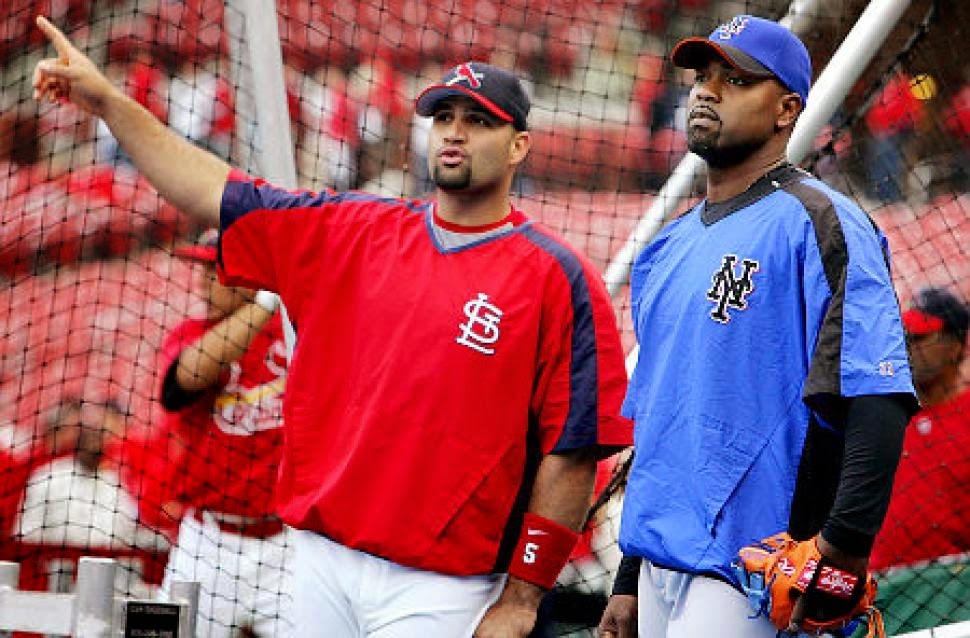
Delgado’s lone grand slam of the year was against the Cardinals in an 8-7 victory on August 22nd.  He also added a solo home run that game and finished with five RBIs.  Although he lost the war that day, Albert Pujols won the battle of first basemen, also hitting two home runs – a grand slam and a three run – with all seven Cardinals RBIs.  Future Cardinal Carlos Beltran would hit a walk off two run home run off of Jason Isringhausen.

In 2007, Delgado’s numbers would continue to decline.  He was batting under .200 as late as May 3rd, but he would raise his average to .231 by the end of May.  He would miss some time in the middle of September, but came back to hit .297 in the last 10 games of the season.  Overall, he hit .258 with 30 doubles, 24 home runs and 87 RBIs, with 52 walks and 118 strikeouts.  Despite his dip in offense, there was no decline in the field, as he committed eight errors good for a .993 fielding percentage.
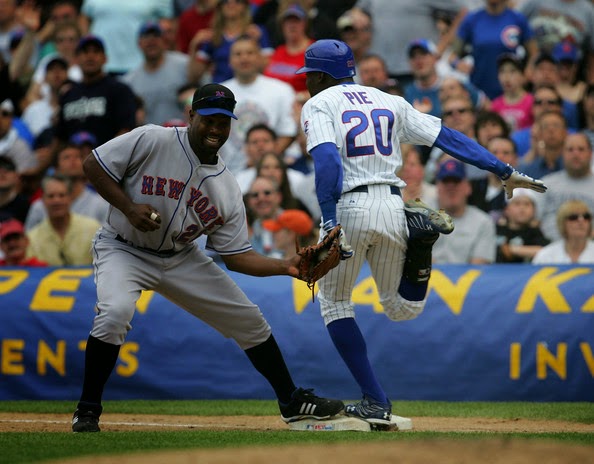
He's more of a cake guy.
2008 would be the last full season for Delgado.  Seemingly healthy again, the 36 year old Delgado’s numbers returned to something closer to the average Delgado season.  At the end of June, he was only hitting .228, but after hitting .357 in July, his season average jumped to .260, and he would hit .292 over the final two months of the season to increase it further.  He was a home run short of the cycle in an 8-6 loss to the San Diego Padres on June 8th.  On June 27th, he went 3-5 with a grand slam, a three run home run and a two run double, finishing the day with nine RBIs in a 15-6 win over the New York Yankees.  He would add his final career grand slam in a 9-6 loss to the Chicago Cubs on September 24th.  On the season, he hit .271 with 32 doubles, one triple, 38 home runs and 115 RBIs, with 72 walks and 124 strikeouts.  He would finish ninth in the NL MVP voting.

Delgado would start the season with the Mets in 2009, but after the first 30 games of the season, he was done.  Overall, he hit .298 with seven doubles, one triple, four home runs and 23 RBIs, with 12 walks and 20 strikeouts.  In his last game on May 10th, he was 1-4 with a double off of Ian Snell in an 8-4 victory over the Pittsburgh Pirates.  In 25 games at first base, he made two errors for a .990 fielding percentage.
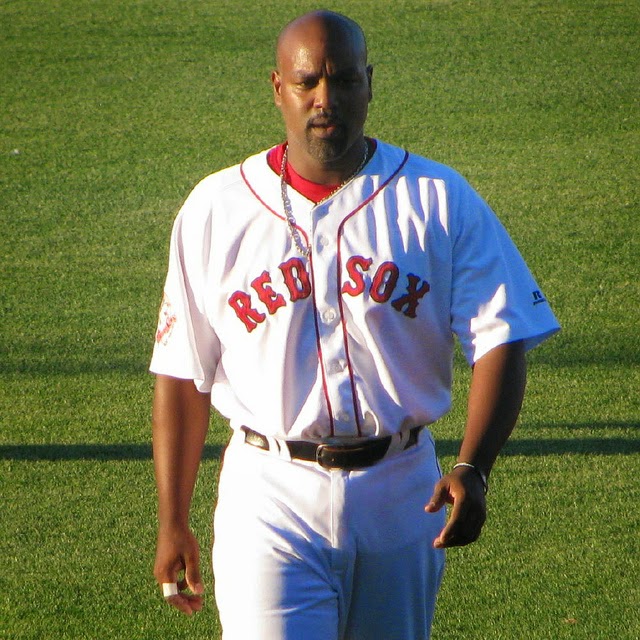
PHOTOGRAPHIC PROOF.
A few days after his last game, he had hip surgery.  He was only expected to miss 10 weeks, but didn’t play another game that season.  Before the 2010 season, he had another procedure on his hip.  In early August, he signed a minor league contract with the Boston Red Sox.  He would only play in five games at AAA Pawtucket, hitting .231 with two RBIs, before suffering another setback.  He announced his retirement in April of the following year.

For his career, Delgado hit .280 with 483 doubles, 18 triples, 473 home runs and 1512 RBIs, with 1109 walks and 1745 strikeouts.  His career on base percentage was .383, and his career OPS was .929.  He was never accused of being fleet of foot, with only 14 career stolen bases, but he actually had more intentional walks – 186 – and hit by pitch – 172 – than double plays grounded into – 152.  Despite all of his games at catcher in the minor leagues, he only caught five errorless innings in two games in the majors.  Overall at first base, in 1767 career games, he only made 129 errors for a .992 fielding percentage, but never won a Gold Glove award.
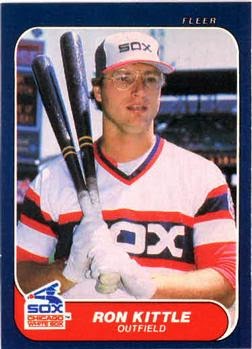
It's easier to hit with two bats.
Despite his average being, well, average, his on base percentage is actually 147th best in major league history.  His slugging percentage of .546 ranks 28th all time, and his OPS ranks 37th all time.  His 473 home runs rank 31st all time.  One stat that stuck out to me is that his hit by pitch total ranks 14th all time.  That’s somewhat unusual for a slugging first baseman.  Jason Giambi (180) and Andres Galarraga (178) rank just ahead of him, but other than that, not many other first basemen among the leaders in that category.  His intentional walk count ranks 22nd all time, and his HR/AB ratio of 15.4 is 23rd all time, right between Ron Kittle and Ken Griffey, Jr.  He is one of six major league players to have hit 30 home runs in 10 consecutive seasons, the others being Alex Rodriguez, Barry Bonds, Albert Pujols, Jimmie Foxx and Sammy Sosa.

It will be VERY interesting to see what kind of response that Delgado gets from Hall of Fame voters next year when he first becomes eligible.  Never linked to any sort of steroid allegations, that may earn him a few votes alone.  He was also the 2006 winner of the Roberto Clemente Award.  Before we feel sorry for Delgado, worrying he might not make the Hall of Fame, let’s not forget that he made a crap-ton of money in his career – well over $140 million.  But he’s used some of that money for good use.  He was, and still is, quite active in charitable causes in his native Puerto Rico.

Here’s to you, Carlos Delgado!  We might not sleep on a pile of money at night, but most of us can certainly empathize with your career mismanagement.

Friday, September 26, 2014

The Other Dude That's Retiring

Today, I’m doing a quick blog that will hopefully distract you from the Jeter love-fest that’s been going on.  Don’t forget, there is another dude retiring – Paul Konerko.  Konerko has been a solid, consistent player for the past 15 years with the Chicago White Sox.  While I don’t really have time to go into a full on examination of his career, I wanted to find out if Paul Konerko was a Hall of Famer.  I really wanted it to be closer, but when you compare against a few other players, the answer is a solid probably not.

Comparing him against fellow White Sox' teammate and Hall of Famer Frank Thomas, Hall of Fame hopeful but probably not Fred McGriff, another fellow White Sox' teammate Jim Thome, and Hall of Famer Johnny Mize, you can see that Konerko doesn't really stack up against those guys.


Konerko just didn't have the combination of things that really puts some of these other guys over the top.  He didn't hit 500 home runs.  That's not necessarily an automatic entry into the hall nowadays, but it certainly would have helped.  He didn't strike out an excessive amount - his career high was 117 in 2004 - but that being the case, the voters probably would want a higher batting average.

Mize didn't get into the hall through regular voting.  He was elected by the Veteran's Committee.  You have to remember that Mize lost three full seasons to military service though.  And look at that strikeout to walk ratio.

In 1998, the Cincinnati Reds traded Konerko to the White Sox for Mike Cameron.  What if instead the Reds had traded him to the Yankees?  Maybe for Ricky Ledee?  Come on Reds fans, doesn't that sound like a trade they would make?  Or maybe for Paul O'Neill.  Bring him back to Cincinnati to finish his career and provide some veteran leadership.

So, if Konerko went to the Yankees, would he be a Hall of Famer?  The Tino Martinez era was pretty brief in New York.  He would be gone by the end of 2001.  The Yankees then wouldn't have had to sign Jason Giambi.  Konerko would have just been able to hit in the best lineup in the first half of the 2000's.  He almost certainly would have had better numbers, and the shine associated with playing in New York and the number of World Series rings would had definitely bolstered his cause (Don Mattingly would like to point out that BOTH of those things are necessary).

No, Paul Konerko isn't a Hall of Famer.  But let's not just sit back and watch #2 get all the glory these last few days of the season.

Thursday, September 25, 2014

The Day Mark Whiten and Lonnie Maclin Set Career Highs

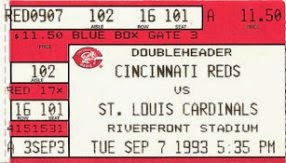
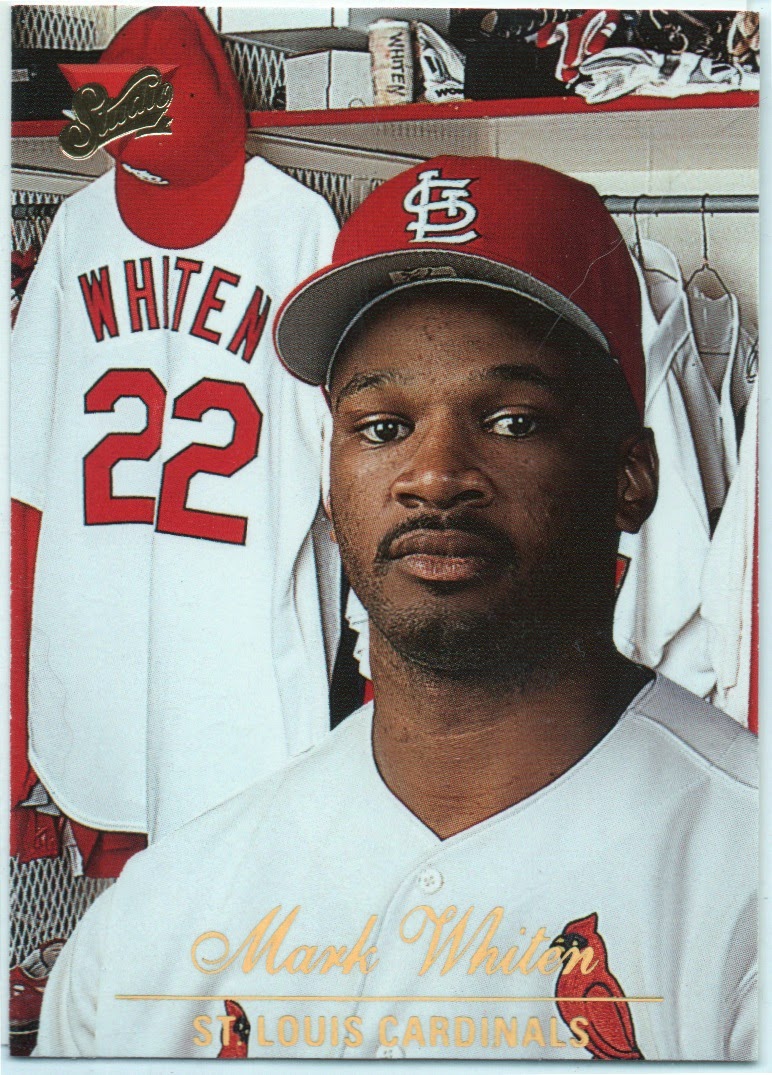
Being a St. Louis Cardinals fan, there’s not much that I care to remember from the early 1990’s.  But there’s one thing that I’ll never forget, and that’s Mark Whiten’s four home run game on September 7th, 1993.
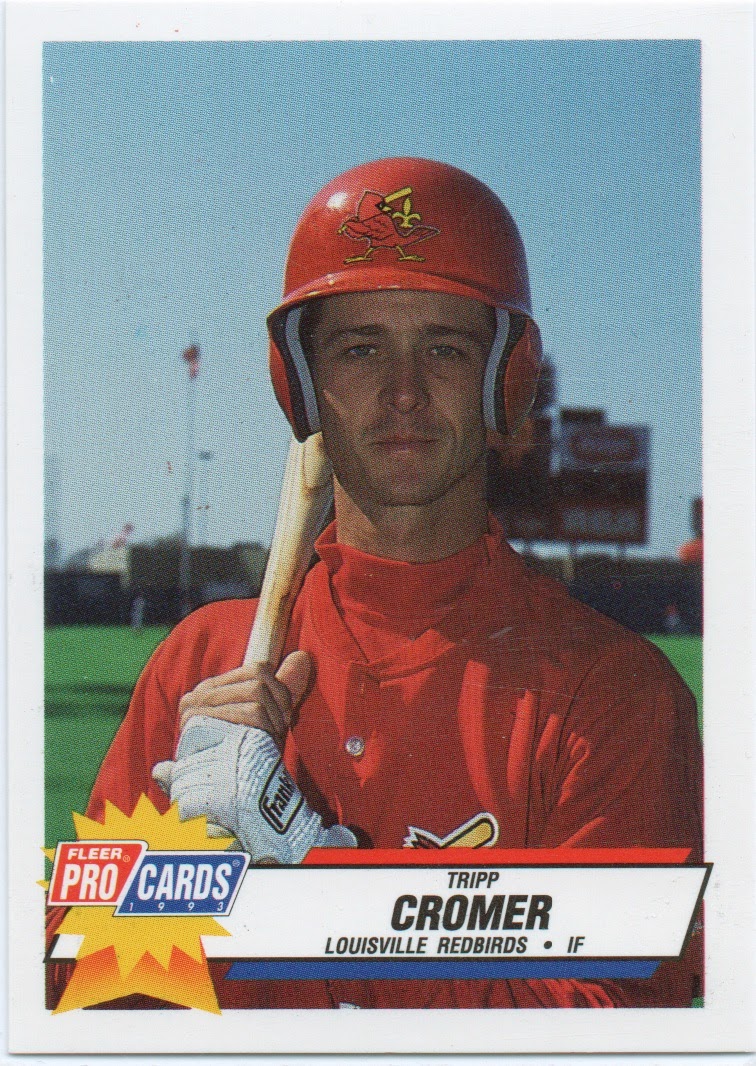
This was actually the second game of the day.  The Cardinals lost the first game 14-13 to the Cincinnati Reds.  In the top of the eighth, the Cardinals exploded for seven runs, turning a 9-6 deficit into a 13-9 lead.  They actually had runners at second and third base with one out with seven runs in, but for some reason, Stan Royer didn’t attempt to score on Tripp Cromer’s groundout to second, and then Luis Alicea struck out looking to end the inning.  Actually, I think I remember that exact scenario unfolding watching the Louisville Redbirds in 1989.  Anyway, Mark Whiten had a small part in the eighth inning action, drawing a bases loaded walk off of Scott Ruskin, scoring Gregg Jefferies, earning his first RBI on the day.

The Reds would score three runs in the bottom of the eighth off of a Dan Wilson bases loaded single and a Jack Daugherty sac fly.  Jefferies would single, steal a base, and advance to third on a sac fly in the top of the ninth, but he was stranded there after Jeff Reardon got Bernard Gilkey to pop out to second base to end the inning.  In the top of the ninth, Jacob Brumfield doubled with one out, and Hal Morris followed that with a walk.  Reggie Sanders then finished it off of Todd Burns with a triple to end the game.  Whiten quickly put his learnings from Pensacola Junior College to work, deducing that the Cardinals would need to score more than 14 runs if they were to win the nightcap.  He sat down between games with Lonnie Maclin and quickly went to work on a plan to do just that.

This is beautiful.  You can
see all four levels of seats
in old Cardinal Stadium.
WHOA THERE, HOSS.  Who the hell is Lonnie Maclin?  If you have to ask that, you’re not a true Cardinals fan.  At least a true Cardinals fan that doesn’t have the last name “Maclin”.  Maclin made his major league debut in the first game that day, getting his first career hit off of John Roper to lead off the sixth inning.  Unfortunately, his .333 average at that time would fall to .077 by the end of the season.  That’s what happens when you don’t get another hit in 10 more at bats.  September 7th, 1994 was the only day that he would ever start a major league game, and he got two starts that day.  But if there was ever a day to be on the field, it was this day.
In game two that day, Maclin would be inserted second in the lineup, between Geronimo Pena and Gilkey.  Whiten would hit down in the six hole between Gerald Perry and Tom Pagnozzi.  After Pena walked to lead off the game, he was thrown out at second off of Maclin’s grounder to short.  Maclin then proceeded to steal second, looking into the dugout and giving Whiten two thumbs up.  After a Todd Zeile walk and a Perry single, Whiten went to work.  He hit a grand slam to open things up that day.  Pagnozzi, still in awe of how beautifully the plan was working, could only muster a fly out to left to end the top half of the inning.  Cardinals 4, Reds 0.

The Reds would keep the momentum from the first game going in the bottom of the first.  Thomas Howard led off with a walk, followed by a double from Brumfield.  Morris then hit a sac fly, scoring Howard, and then Brumfield scored after stealing third and an error on the throw from Pagnozzi.  After that point, though, Bob Tewksbury was pretty much lights out.  He went the distance, allowing no more walks or runs, and only six more hits.  After the first inning, it was Cardinals 4, Reds 2.

The next three innings were scoreless affairs, with a Maclin strikeout and Whiten pop out sprinkled in, so let’s fast forward to the fifth inning.  In the top half of the frame, Tewksbury would lead off with his second walk of the day.  He advanced to second on a wild pitch, and then Pena bunted him over.  That’s when Maclin summoned his inner Whiten and hit a sac fly to center field, scoring Tewksbury.  Brumfield would single off of Tewksbury in the bottom half of the inning, but that was it for the Reds.  Cardinals 5, Reds 2.

Mike Anderson relieved Reds starter Larry Luebbers to start the sixth inning.  Anderson promptly walked Zeile and Perry to start the inning.  That’s when Whiten decided to get halfway to the home run cycle, hitting a three run shot, giving him seven RBIs on the day to that point.  Rounding the bases, he gave a big salute to Maclin, as they were now over halfway to their goal of scoring more than 14 runs.  With tears in his eyes at the beauty of the unfolding plan, Pagnozzi grounded out to short.  Cromer and Tewksbury went down quietly as well, and the Reds failed to make any noise in the bottom of the frame.  Cardinals 8, Reds 2.
Anderson remained in the game to start the top of the seventh inning for the Reds.  After Pena struck out, Maclin fouled out to third base.  Shamed by this, Maclin hung his head and went back to the dugout.  Whiten, always a glass-two-thirds-of-the-way-full kind of guy, told him to keep his head up, and actually ordered some nachos for him from a vendor close by.  While this was happening, Gilkey and Zeile singled, setting up Perry for an RBI single.  Whiten, batting gloves still slathered in nacho cheese, deposited another ball over the wall, giving him three home runs and 10 RBIs on the day to that point.  While running around the bases, Whiten spelled out M-A-C-L-I-N, YMCA-style.

Surprisingly, Whiten’s third dinger of the day didn’t knock Anderson out of the game.  That came a batter later, when Pagnozzi singled.  Chris Bushing entered the game and retired Cromer to end the top of the inning.  Brian Dorsett would pinch hit and single for Bushing in the bottom of the inning, but that was it for the Reds.  Cardinals 12, Reds 2.

Rob Dibble entered the game in the top of the eighth for Cincinnati.  Tewksbury struck out before Pena swelled up and hit a home run.  Maclin was the next batter, but the only thing that he could do was ground out to second.  Maclin was no Whiten.  He knew it, Whiten knew it, the nacho vendor knew it.  At that point, Whiten autographed his cleats and gave them to Maclin (they weren’t actually his cleats; they were Jim Lindeman’s cleats from 1989 that fell behind the industrial washing machines).  The Reds couldn’t get anything going in the bottom of the eighth.  Cardinals 13, Reds 2.

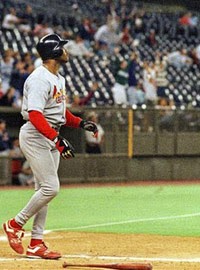
Dibble remained in the game in the ninth.  Royer struck out to start the frame, but then Perry singled to center field.  Whiten came up and did the only thing he could do.  He hit a home run.  He rounded the bases cleatless, wanting Maclin to believe that he actually gave him his cleats an inning earlier.  Whiten now had four home runs and 12 RBIs on the day, and the plan that he and Maclin sat down and concocted had come to fruition.  They had scored more than 14 runs.  Whiten was the last baserunner of the day for either team.  The Cardinals won 15-2.

Whiten and Maclin both achieved career highs that day for RBIs in a game.  Maclin’s one RBI was the only RBI of his career.  Whiten’s 12 RBIs tied fellow Cardinal Jim Bottomley for most in a game in major league history.  He also tied the Padres’ Nate Colbert for most RBIs in a double header with 13.  His four home runs also tied several players for most in a game.
I would write a long paragraph about Maclin’s career, but I would do so at the risk of being too wordy.  He was actually drafted by the Reds in the 10th round of the amateur draft in January 1986, but didn’t sign.  The Cardinals drafted him in the third round of the June secondary draft that year, and he signed on to play for his hometown team.  It took him seven years to reach the majors.  He was there for a month, then spent the next eight years playing independent ball and in the Mexican league before finally calling it quits in 2003.

Whiten set career highs in 1993 in games played, at bats, runs, hits, home runs and RBIs.  He was also player of the week twice that season.  The first time was the week of July 18th when he hit .385 with three home runs and nine RBIs (this was in four games in the short week of the All Star game).  And of course, the second time was the week of September 12th, when he hit .321 with four home runs and 14 RBIs.

And thaaat was a
70 MPH fastball.
Whiten would only play in 100 or more games one other time in his career – 1996.  After his time ended in St. Louis in 1994, he played for six different teams in six years.  In his final three seasons, he returned to Cleveland, which was the second team he played for, and he went to the post season the only time in his career in 1998.  He also pitched one inning for the Tribe that season.  Throwing the eighth inning of a 12-2 loss to the Oakland A’s on July 31st, he allowed one hit, one run, two walks, and a hit batter, and he also struck out the side.  He allowed a double to Jason Giambi, and struck out Mike Blowers, Miguel Tejada and Mike Neill.
With 105 career home runs, only three other players who have hit four home runs in a game have few than him.  Two of those players (Bobby Lowe and Ed Delahanty) accomplished the feat in the 19th century, and the other one did it in 1948 (Pat Seerey).  Of all of the players with 10 or more RBIs in a game, only Phil Weintraub and Norm Zauchin have fewer RBI’s than Whiten’s career total of 423.

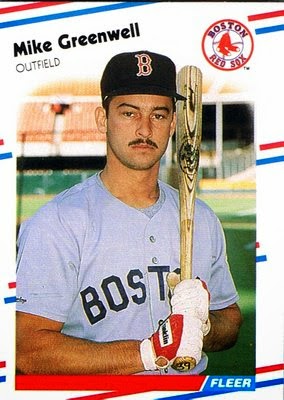
Lastly, I would like to bring up the record for most RBIs in a game where a player accounted for all of his team’s runs.  That feat was accomplished by Mike Greenwell on September 2nd, 1996.  Greenwell knocked in all nine of the Red Sox’ runs in a 9-8, 10 inning victory over the Seattle Mariners.  Manning left field for the Mariners that day?  Mark Whiten.

Sunday, September 21, 2014

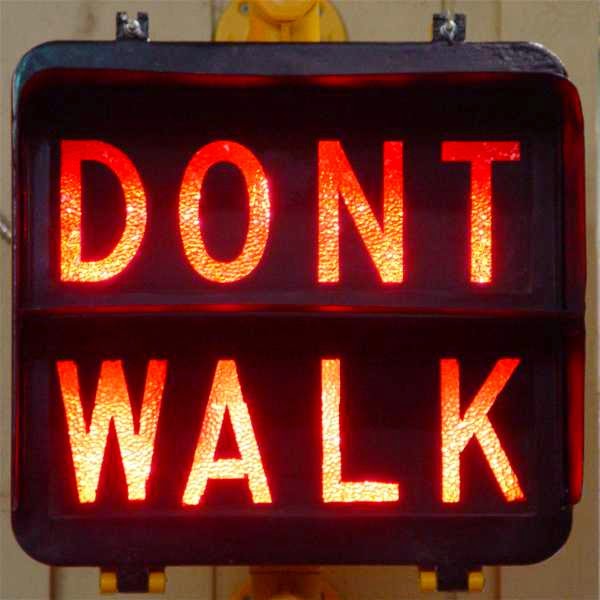
DONT WALK

Being somewhat of a grammar nazi, I’ve always looked at the “Walk/Don’t Walk” sign with a bit of sadness.  There’s no apostrophe in the “Don’t”, I’m not sure who to tell, and it probably wouldn’t matter anyway.  I get that there’s space consideration there, but couldn’t you just cut out an apostrophe in the black?  Isn’t there just one big red light illuminating a cutout?  I don’t know.  And nowadays, the public schools have gotten so bad, they just go with white and red people.  You don’t even have to read!  But this is a baseball blog (hopefully fairly grammatically correct).  We’re not here to talk about apostrophes.  Today, we’re going to talk about someone who took the DONT WALK sign to heart, Dan Quisenberry.

Quisenberry signed with the Kansas City Royals as a free agent in June of 1975, out of the University of La Verne in La Verne, CA.  The Leopards have produced a total of 10 major league players, but Quisenberry is the last one to have played in the majors.

Upon his signing, the Royals assigned Quisenberry to A ball Waterloo.  It was there where he would make his only professional start, which just happened to also be a complete game.  Overall there, he would go 3-2 with a 2.45 ERA and four saves with 31 strikeouts vs. just six walks (one intentional) across 44 innings in 20 games.  This earned him a promotion to AA Jacksonville to finish the 1975 season.  There, he went 0-1 with a 2.25 ERA and one save with two strikeouts vs. four walks (one intentional) across eight innings in six games.

The Royals would give Quisenberry the same schedule in 1976.  Starting again at Waterloo, he went 2-1 with a 0.64 ERA and 11 saves with 19 strikeouts and nine walks (four intentional) across 42 innings in 34 games.  Those numbers, plus a WHIP of 0.881, earned him another promotion back to Jacksonville.  There, he went 0-1 with a 2.25 ERA and six strikeouts vs. four walks (two intentional) across 12 innings in nine games.

Quisenberry would spend the next two seasons in Jacksonville, where he would combine to go 7-3 with a 1.17 ERA and 21 saves with 62 strikeouts vs. 23 walks (eight intentional) across 138 innings in 81 games.  He would be promoted to AAA Omaha for 1979, where he would go 2-1 with a 3.60 ERA and five saves, with 16 strikeouts vs. 10 walks (one intentional) in 35 innings across 26 games.

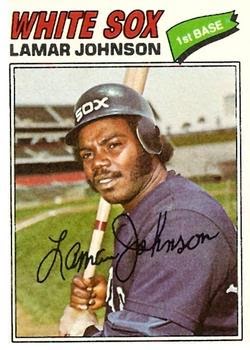
The Royals finally came to their senses in early July.  Quisenberry was called up, and he made his Major th, 1979.  In a 4-2 loss to the Chicago White Sox, he entered the game in the top of the seventh and induced a ground ball double play off the bat of Lamar Johnson.  In the eighth, he allowed a single to Rusty Torres, who was quickly erased by another ground ball double play off the bat of Greg Pryor.   In the ninth, he allowed a double to Alan Bannister amid three more groundouts.  The Royals tried to put something together in the bottom of the frame, with U.L. Washington hitting a one out single to center field, but a Willie Wilson pop out and George Brett ground out ended the day.
League debut on July 8

Quisenberry would pick up his first major league victory 14 days later in a 7-6 win over the Texas Rangers.  He allowed his first run in the bottom of the eighth, blowing the save, but the Royals scored a run in the top of the ninth, and he shut the door in the bottom of the frame.  The next day, he would get his first career save against the Rangers.  Overall for his first half season in baseball, one probably didn’t see this guy as a future dominant closer.  He finished 3-2 with a 3.15 ERA and five saves with 13 strikeouts vs. seven walks (five intentional) in 40 innings across 32 games.  He also added three holds, but he had five blown saves.  If you look at his outings though, there were two instances where he gave up four runs each in a total of three innings.  If you take those two outings out, his ERA falls to 1.46.  In both of those outings, he allowed two home runs.  He only allowed one other home run in the other 37 innings he pitched.

The 1979 Royals only had a total of 27 saves, and it took six different pitches to achieve that total.  They finished the season 85-77, three games back of the California Angels.  If they were going to get over the hump, they were going to need to do better than 27 saves.  And so they did.

Quisenberry opened the 1980 season as the closer in Kansas City, and never looked back.  At the end of May, he was having a pretty decent season, sitting at 3-2 with a 2.61 ERA and eight saves.  Two months later, at the end of July, he was 7-4 with a 3.12 ERA and 20 saves.  Then came August.  He pitched in 18 games that month, going 4-1 with a 1.03 ERA and 11 saves, with only one blown save.  The Royals were 16-2 in games in which he pitched that month.  He had 10 walks that month, but seven of those were intentional, including three on the day where he had his only blown save.  He gave up a run in the bottom of the ninth, allowing the Toronto Blue Jays to tie it at three.  Quisenberry would pitch FOUR MORE INNINGS that day without allowing a run, before the Jays finally broke through for a run in the bottom of the 14th inning off of Rawly Eastwick.  Shamed by the outing, Eastwick would never pitch again for the Royals.

Quisenberry had a somewhat rough September, when he went 1-2 with a 5.48 ERA and only two saves.  On September 4th, he allowed six runs on seven hits and a walk (intentional of course) in a third of an inning in a 9-5 loss to the Milwaukee Brewers.  The Brewers scored eight of those runs in the ninth inning off of nine singles and the intentional walk.  The Royals though accomplished what they set out to do though.  They had a total of 42 saves on their way to a 97-75 record, finishing a full 14 games ahead of the second place Oakland A’s.  They would sweep the Yankees in the ALCS before losing to the Phillies in six games in the World Series.  Quisenberry was excellent in the ALCS, but struggled in the World Series, allowing six runs in 10 1/3 innings, going 1-2 with a 5.23 ERA and one save.  Overall for the season, he was 12-7 with a 3.09 ERA and a league leading 33 saves with 37 strikeouts vs. 27 walks (15 intentional) in 128 1/3 innings across 75 games.  He finished fifth in the AL Cy Young Award voting, and eighth in the AL MVP voting.

1981 wasn’t too bad of a season for Quisenberry.  The strike that year really hurt him putting up elite numbers, but it actually seemed to help him.  Prior to the strike in mid-June, he was 0-3 with a 2.86 ERA and nine saves, with 11 strikeouts and nine walks (five intentional).  One of his losses came in another five inning effort where he scattered nine hits and a walk, allowing three runs in an 8-7 loss to the Boston Red Sox on May 4th.  Sixteen days later, he lost another game, allowing a hit and issuing THREE intentional walks in a 5-4 loss to the New York Yankees.

After the season resumed in mid-August, Quisenberry only allowed three earned runs the rest of the season.  He went 1-1 with a 0.79 ERA and nine saves, with nine strikeouts and six walks (three intentional).  His post-strike WHIP was 0.882.  The Royals made the playoffs, but they were swept in the ALDS by the A’s.  Overall for the season, he finished 1-4 with a 1.73 ERA, with 20 strikeouts and 15 walks (eight intentional) in 62 1/3 innings across 40 games.  He only allowed one home run all season.

The 1982 season began a four year span where Quisenberry was not only one of the best relievers in the game, but one of the best overall pitchers in the game.  He carried the second half momentum from ’81 right into April, where he pitched in seven games, going 0-1 with six saves.  He pitched a total of 14 innings, and only faced 50 batters.  That’s just eight over the minimum.  By mid-season, he was 4-3 with a 2.35 ERA and 20 saves.  That pace slowed a little, but he still finished 9-7 with a 2.57 ERA and a league leading 35 saves, with 46 strikeouts and 12 walks (two intentional) in 136 2/3 innings across 72 games.  It was the first season of three straight where he walked less than a batter…per nine innings.  He made his first All Star team, finished third in the AL Cy Young voting, and ninth in the AL MVP voting.  The Royals finished 90-72, but that was three games back of the Angels.

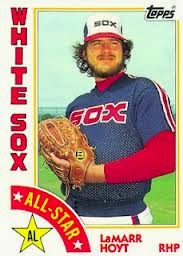
1983 was perhaps Quisenberry’s finest season.  At the end of April, he was 1-1 with a 2.04 ERA and four saves vs. three blown saves.  That was the highest his ERA would be the rest of the season, and in the other five months, he would only have four more blown saves.  He was lights out in May, earning a save in all eight opportunities with a 0.46 ERA, allowing one run in 19 2/3 innings.  He had two blown saves in June, but won both of those games, and added seven more saves.  July saw one blown save – a game he won on July 22nd throwing a season high 5 1/3 innings in relief in the 3-2 victory of the New York Yankees.  He had his last blown save of the season on August 19th, and four days later, he would have his last loss of the season.  From August 25th on, he was perfect in his 11 save opportunities.  He allowed four runs in three innings in a non-save situation on September 28th, but other than that outing, he only allowed one other run in 27 1/3 innings.  In those 15 games, he didn’t walk a batter.  Overall for the season, he went 5-3 with a 1.94 ERA, with 48 strikeouts and 11 walks (two intentional) in 139 innings across 69 games.  His 45 saves destroyed the old single season record of 38 set in 1973 by John Hiller.  He set career highs in saves, innings and K/BB ratio, and career lows in ERA (other than the strike shortened 1981 season), WHIP, hits/9 and BB/9.  He was again an All Star, he finished sixth in the AL MVP voting, and finished second in the AL Cy Young voting to LaMarr Hoyt.  Despite his efforts, the Royals finished 79-83, which was good enough for second place, but still 20 games back of Hoyt’s White Sox.


Quisenberry saw much of the same success in 1984.  At the end of June, he had 20 saves and a 2.09 ERA.  In the second half of the season, he earned 24 more saves and a 3.13 ERA.  The Royals rode him hard down the stretch.  In September, he was 2-0 with eight saves and two blown saves.  In 12 games that month, he pitched 24 1/3 innings.  In five of those games, he went at least two innings.  Overall that season, he went 6-3 with a 2.64 ERA and 44 saves, with 41 strikeouts and 12 walks (four intentional) in 129 1/3 innings across 72 games.  He was an All Star for the third and final time of his career, finished third in the AL MVP voting behind fellow reliever Willie Hernandez and Kent Hrbek, and once again he finished second in the AL Cy Young voting, that award also going to Hernandez.

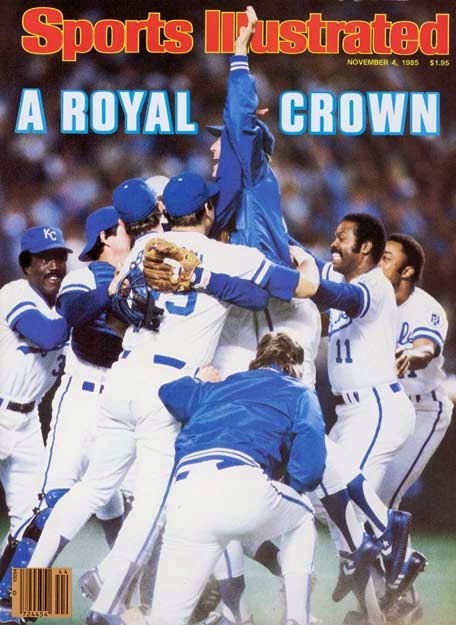
1985 would be the last year where Quisenberry would be a dominant reliever.  The first half of the season was pretty pedestrian, at least by his standards.  Through the end of June, he was 4-4 with a 2.67 ERA and 14 saves vs. five blown saves.  He gave up 65 hits and nine walks in 57 1/3 innings for a 1.291 WHIP, but some of this may have been fueled by a .302 BAbip, which was far above his .258 BAbip at that point in his career.  The second half of the season went a little better, as he went 4-5 with a 2.13 ERA and 23 saves vs. seven blown saves.  He threw a total of 71 2/3 innings in 46 games in the second half.  Overall, he went 8-9 with a 2.37 ERA and 37 saves, with 54 strikeouts and 16 walks (eight intentional).  The Royals would finish one game ahead of the Angels, and after beating the Blue Jays in the ALCS, they defeated the St. Louis Cardinals in seven games to become World Series champions.  That post season, he went 1-1 with a 3.00 ERA and one save.

Quisenberry then decided to fall off a cliff, as far as production went.  In 1986, he went 3-7 with a 2.77 ERA and only 12 saves.  He walked 24 batters (12 intentionally) and only struck out 36 in 81 1/3 innings across 62 games.  Despite only having 12 saves, he still led the team, as the Royals only had 31 total and finished third in the AL West.  In 1987, he would only pitch in 49 innings across 47 games and earn eight saves.  He went 4-1 with a 2.77 ERA and 17 strikeouts vs. 10 walks (three intentional).

1988 would mark Quisenberry’s last season in Kansas City.  He earned his last save as a Royal on April 28th, and pitched his last game as a Royal on June 24th.  On July 4th, he was released by the Royals.  Ten days later, he took a trip on I-70 east, and signed with the St. Louis Cardinals.  For the Royals, Quisenberry had a 3.55 ERA over 25 1/3 innings to start the season, and for the Cardinals in July, his ERA was actually a bit lower at 3.24 in 8 1/3 innings.  Then August happened.  For that month, he had a 8.49 ERA in 11 2/3 innings, and in September it was 6.00 in 18 innings.  He didn’t earn a single save in the second half of the season with the Cardinals.  Overall for the year, he went 2-1 with a 5.12 ERA and one save, with 28 strikeouts and 11 walks (three intentional) in 63 1/3 innings across 53 games.

Quisenberry somewhat righted the ship for the 1989 season.  He had a rough April where he had a 5.62 ERA in eight innings, but by the time July 6th rolled around, he had four saves and a 1.99 ERA.  Two days later, he gave up three runs in two innings, but he wouldn’t give up multiple runs again until his last two outings of the season, giving up two runs each in those.  For the season, he went 3-1 with six saves, with 37 strikeouts and 14 walks (nine intentional) in 78 1/3 innings across 63 games.

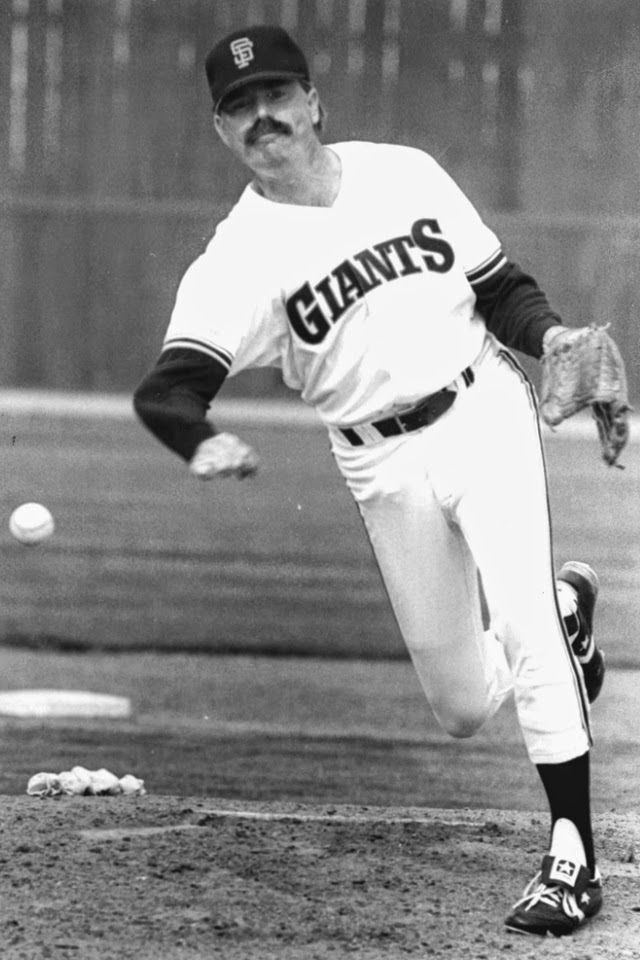
The Cardinals released Quisenberry at the end of the 1989 season.  For 1990, he signed with the San Francisco Giants.  This did not go well.  He only pitched in five games for the Giants, all in April, before he tore his rotator cuff, which led him to retire.  He gave runs in three of those games; 10 total across 6 2/3 innings.  He would pitch his last game on April 23rd, giving up three runs in 2 1/3 innings in a 13-3 loss to the San Diego Padres.  Quisenberry did go out in style though.  That day, the last hit, walk, and run he ever gave up was to Joe Carter, Jack Clark and Tony Gwynn respectively.

For his career, Quisenberry was 56-46 with a 2.76 ERA and 244 saves, with 379 strikeouts and 162 walks.  Of those walks, 70 were intentional.  Breaking that out, he unintentionally walked a batter every 11 1/3 innings.  Quisenberry’s first balk in the majors came on April 9th, 1988 – his 556th game in the majors.  He would end up with a total of five.  He faced a total of 4247 batters in his career.  He hit SEVEN of them.  He threw four wild pitches in his career, or one every 261 innings.  As a comparison, the best reliever of all time, Mariano Rivera, faced 5103 batters in his career.  He hit 13 of them, and threw 13 wild pitches – one every 98.7 innings.

Quisenberry had a career WHIP of 1.175, which seems a bit high considering his lack of walks.  He was the epitome of “pitch to contact”, allowing 1064 hits in his 1043 1/3 innings.  However, only 59 of those hits left the yard, good for a 0.5 HR/9 inning ratio.  Although his K/9 inning was comically low at 3.3, his low walk rate led to a 2.34 K/BB ratio.  His career BB/9 ratio of 1.397 is the 20th lowest of all time.  Of the 19 pitchers in front of him, only two pitched in the 20th century, the last one throwing his final game in 1926.

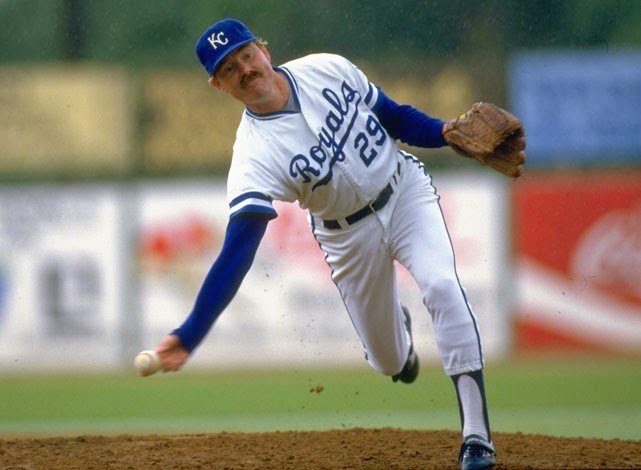
Now that we’ve reviewed some of these numbers, I’ll let you in on a little secret.  If you know anything at all about Quisenberry, you probably remember the almost-underhanded delivery he had.  You may assume that he always did that, but you would be wrong.  He didn’t develop that style of pitching until spring training in 1980.  His manager suggested the change because he didn’t have a good fastball, and requested that Quisenberry learn the style from Kent Tekulve.  So not only was Quisenberry a master control artist, he did it using a pitching style that was totally foreign to him.

In 1996, in his first year on the Hall of Fame ballot, he only received 3.8% of the votes and dropped off. 

Quisenberry was diagnosed with brain cancer in January 1998, and passed away in September of that year.  That same year, he was elected to the Royals Hall of Fame.


Dan Quisenberry, wherever you are, I’m not sure of your feelings on the DONT WALK sign, but thank you for taking it to heart and championing its cause.